Inside the Mind That Shapes Stories
About the Author
Lee Lucero
Lee Lucero grew up in Albuquerque, New Mexico, the place where Bugs Bunny missed his left turn, and where Lee learned to navigate a world that rarely offered directions. The desert was a crucible: sun-scorched, bone-dry, and brutally honest. His childhood mirrored that terrain, unforgiving, unstable, and quietly dangerous. He learned to read the danger in the room before breakfast, a survival skill honed through years of abuse, neglect, and the silent calculations required to stay safe.
His only steady lifeline was his godmother, a woman who offered financial support from afar while living on the East Coast. Their relationship wasn’t cruel, but it wasn’t healthy. It was transactional, emotionally distant, and shaped by quiet manipulation on both sides. Lee mirrored the toxic behaviors modeled by the adults around him; he was, for a time, as toxic as the environment he had escaped. Survival had taught him how to adapt, not how to heal.
Without guidance, he made mistakes, some impulsive, some deeply rooted in learned dysfunction, and it took years to unlearn what had been normalized. But amid the chaos, a new path emerged. Lee entered medicine, earning his EMT-Basic certification and laying the foundation for a career in emergency and critical care. For the first time, his ability to read danger became a tool for protecting others, not just himself.
Lee, like many survivors of trauma and abuse, entered medicine not just out of ambition, but out of necessity. Emergency care offered structure, urgency, and a kind of moral clarity he hadn’t known growing up. He found himself drawn to chaos, not because it mirrored his past, but because it gave him a role within it. For the first time, he wasn’t reacting to danger, he was intervening.
Lee’s first marriage lasted only four months, punctuated by a betrayal that cut deeper than most, his cousin slept with his wife. It was a brutal initiation into adult relationships, and it set the tone for years of instability. After that, Lee bounced from relationship to relationship, rarely lasting more than six months. There was one that had potential, something real, something worth building if only Lee could’ve gotten out of his own way.
Then came the spiral: a string of toxic relationships, each more destabilizing than the last. One partner lived with borderline personality disorder, volatile, not malicious, but capable of weaponizing self-harm threats to keep Lee emotionally captive. Another was a covert narcissist, a true wolf in sheep’s clothing. She was a more sophisticated version of his mother, and she broke him. Lee played his part, too, becoming the monster she claimed he was.
When that relationship ended, so did nearly everything else. Lee walked away estranged from his family, save for his godmother. His close circle of friends dissolved except for his loyalist friend. What remained was a mirror, and the long, brutal work of facing it.
He entered therapy and committed to the slow, unglamorous process of healing. He lives with complex PTSD shaped by childhood abuse and years spent caring for others at their worst and with anxiety that still shadows him. But he lives with intention now. He shows up for the work. And the work continues.
Lee leveled up in medicine, becoming a Respiratory Therapist and eventually stepping into leadership as Interim Clinical Director for Santa Fe Community College. He served as a Clinical Instructor for both Central New Mexico Community College and Santa Fe Community College, mentoring the next generation of respiratory professionals with the same intensity he brought to the bedside. His clinical journey included a stint as an ECMO Specialist, working at the edge of life support, where precision and pressure collide.
A high performer by any metric, Lee earned both the PRN Respiratory Therapist of the Year and Respiratory Therapist of the Year awards. At UNMH, he treated patients from the cradle to the grave, working across every wing of the hospital. He also began developing educational content, creating a series of training videos that helped demystify the role of respiratory therapists and elevate the standard of care.
If you don’t know what a respiratory therapist does, you’re not alone. They’re the Navy SEALs of the hospital, when they do our job well, you never even know they were there. RT’s respond to every emergency: every high-risk birth, every cardiac arrest, every moment when breath becomes a battle.
Respiratory Therapists are there when life begins, and when it ends. We withdraw life support when the time comes. Lee’s held a grieving husband just weeks after his wedding as his wife became an organ donor. He’s felt hearts beat their last under his hands. He’s been directly responsible for ending hundreds, maybe a thousand lives, with respect, empathy, and the kind of quiet grace that doesn’t get noticed.
Lee met his wife just months before COVID turned the world upside down. She’s a physician, a hospitalist, and a deacon’s daughter, equal parts grounded and rebellious. They fell in love on eHarmony before they met in person. Their first kiss was awkward, like she was trying to eat his face, but it didn’t matter. A month later, after a Vegas trip with his female best friend and two other close friends who helped him pick out the ring, Lee proposed the moment she picked him up at the airport. Her response: “Duh.”
She’s been his rock ever since. Part Mary Poppins, part wild child, nerdy, fierce, and full of grace, she taught Lee what love actually looks like. Not the kind built on survival or performance, but the kind rooted in trust, laughter, and showing up even when it’s hard.
When COVID hit, Lee and his wife sent their kids to their grandfather’s ranch for safety. Burnt out and far removed from the Respiratory Therapist who once won RT of the Year, Lee volunteered for the COVID ICU at New Mexico’s largest hospital, UNMH. The shifts were brutal. Respiratory Therapists in the COVID ICU were on an island, others kept their distance, whether to limit exposure or out of fear. Lee embraced the suck and waited for it to feel normal.
COVID was different. Patients didn’t follow the usual arc of treatment and recovery or decline. They lingered for months before deteriorating and dying. The emotional toll was relentless. Like many healthcare workers of the era, Lee emerged fundamentally changed.
His final shift was in December 2020, just a week before the vaccine rollout. Then COVID caught up with him. At first, it looked like he was on the mend. But on New Year’s Eve, the first signs of long-haul neuro-COVID appeared, something with no name, no diagnosis, and no roadmap. What followed were four months of violent vertigo. Going to the bathroom became a full-contact sport. He earned at least one concussion to prove it. His family kept track of “days since last fall.” Night sweats, hearing problems, and two years of rehab followed.
Eventually, the damaged nerve in his head died completely, fixing most of his balance issues overnight and leaving him deaf in his left ear. It was a win either way.
In that time, stripped of his clinical identity and forced into stillness, Lee turned to the one thing he’d always dreamed of: writing. His screenplays began accumulating accolades. And that brings us to now.
If you don’t know what a respiratory therapist does, you’re not alone. They’re the Navy SEALs of the hospital: when they do their job well, you never even know they were there. RTs respond to every emergency, every high-risk birth, every cardiac arrest, every moment when breath becomes a battle.
Lee Lucero has been that person. He has held a grieving husband just weeks after his wedding, as his wife became an organ donor. He has felt hearts beat their last under his hands. He has been directly responsible for soothing hundreds of lives, perhaps thousands, with respect, empathy, and the kind of quiet grace that rarely makes the headlines. Later, he trained as an ECMO Specialist, working in trauma, neuro, burn, pediatric, and neonatal ICUs. He spent two decades, learning to be a steady presence in other people’s worst moments.
None of it prepared him to recognize what was happening in his own life.
Lee grew up in a home where CYFD visits were as frequent as the rent. His mother was a masterclass in performance: warmth in public, control behind closed doors. His stepfather, a journalist by day, taught him that stories had to hurt to matter. He took both lessons seriously. By twelve, child services had intervened. By sixteen, he had his own lease, two jobs, and a community college class schedule. Poverty wasn’t a backstory; it was Tuesday.
What followed were years of learning the same patterns in different disguises. A relationship with someone living with borderline personality disorder: volatile, not malicious, but capable of using self-harm threats to keep him emotionally captive. He wasn’t a passive participant. Both of them were damaged, both of them were surviving, and neither of them were innocent. Then came a covert narcissist, patient and deliberate, a more sophisticated version of the woman who raised him. She didn’t wound; she dismantled. Lee played his part there too, becoming at times the very thing she accused him of being. He doesn’t excuse it. He examines it.
Therapy wasn’t a choice; but the only path. What emerged on the other side was a different kind of fluency: the ability to read predatory patterns before they fully form, to name dynamics that most people don’t have language for, and to trace the mechanisms of manipulation through both personal scar tissue and academic research.
Unlikely Predators is more than just a book. It’s a true crime analysis built on peer-reviewed psychology, court records, and survivor testimony, examined through the eyes of someone who has been on the inside of these dynamics and made it out the other side.
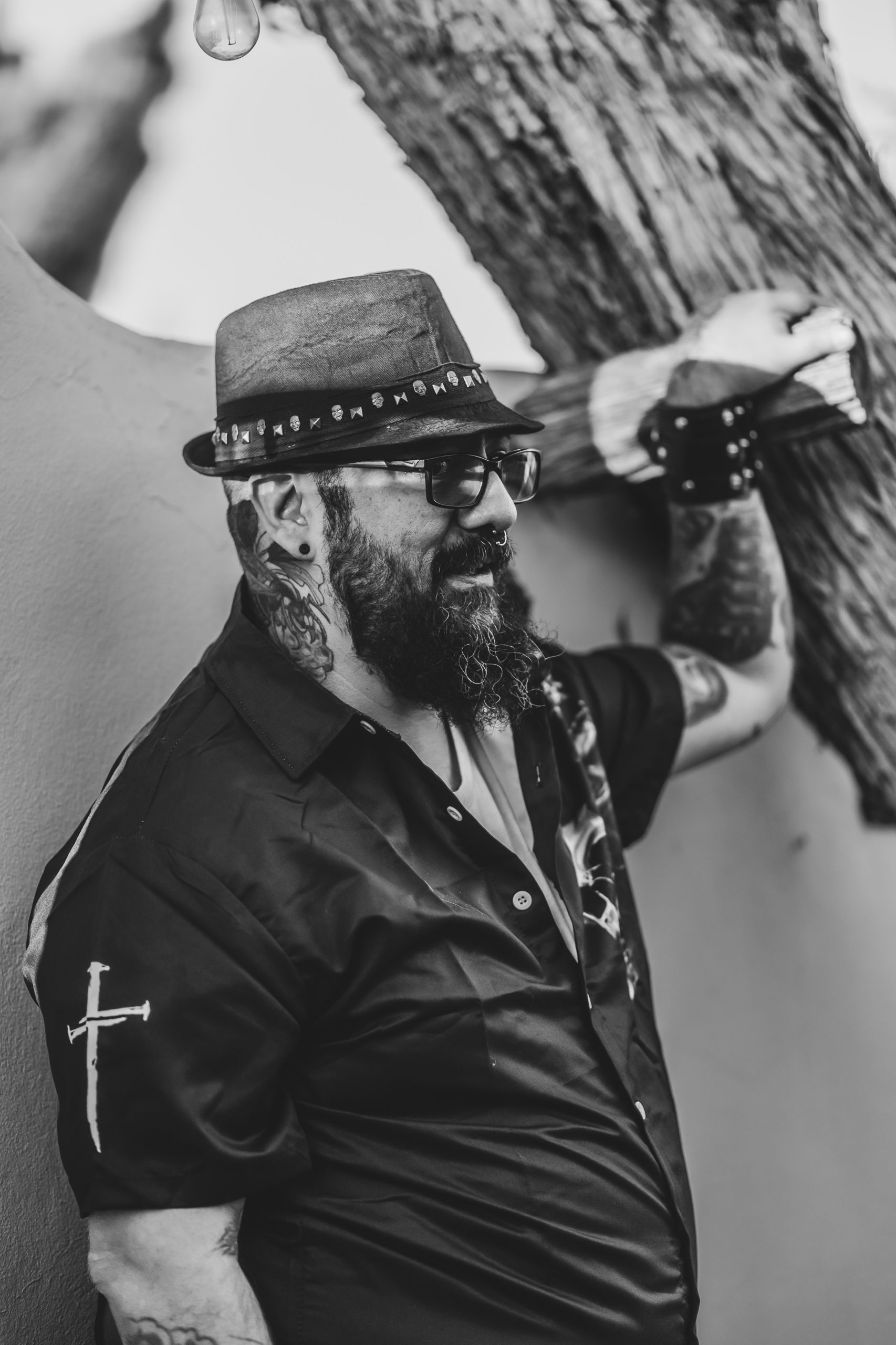
Lee lives in New Mexico with his wife and is a stepfather to four kids, three of them at home. He loves tattoos, road trips, metal and punk, and the kind of concerts that leave your ears ringing for days.
Now a prolific author, he was a formerly a trained respiratory therapist.